Two metals, one plate. A corrosion-resistant stainless or nickel-alloy surface is fused onto a carbon or low-alloy steel base, so you buy alloy only in the millimetres that actually meet the medium — and ordinary steel everywhere else.
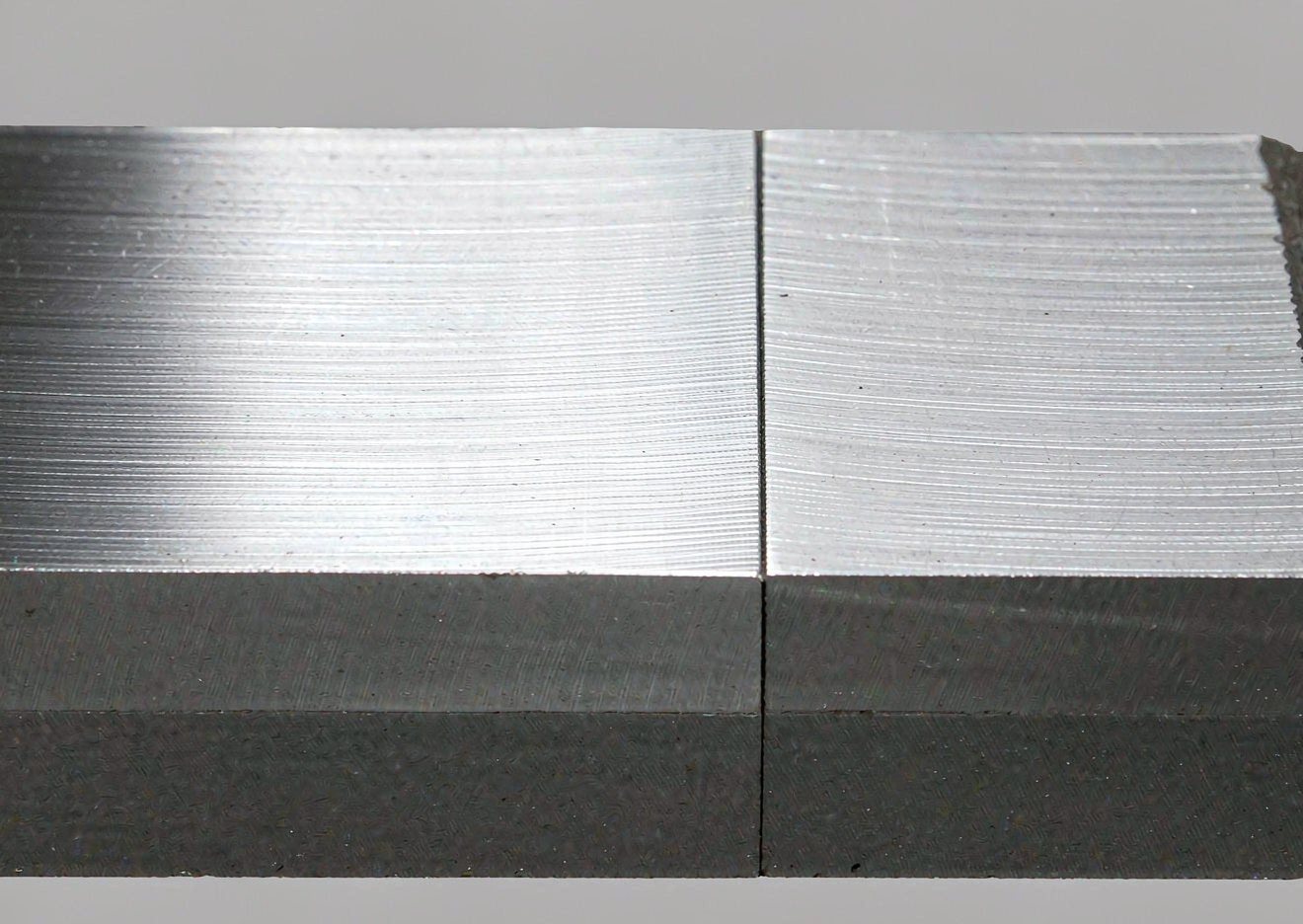 Bond interface · macro section
A clad plate is a single piece of steel made of two different metals joined across their whole contact surface. The top layer is 1 to 6 mm of stainless steel or nickel alloy. The rest — the structural part — is carbon or low-alloy steel.
Because the two metals are fused together under extreme pressure or heat, the boundary between them is a real metal bond, not glue and not a mechanical fit. The plate bends as one piece. It welds as one piece. It does not come apart.
Section through a single-sided clad plate
Most vessels and tanks only ever see the medium from one direction. But a surprising number of jobs — two-sided exposure, exposed decorative faces, or a plate that has to stay flat through heavy welding — are better served by cladding both faces.
Both produce a genuine metallurgical bond. Which one you should order depends on the thickness combination you need and the size of the plate.
* Depending on the cladding grade and base steel combination. Alloy 800H and nickel alloys extend the upper limit well beyond this.
| Layer | Typical grades | Thickness |
|---|---|---|
| Cladding | 304, 304L, 316, 316L, 316Ti, 321, 310S, 904L, 2205, 2507, alloy 825 / 625 / C-276, copper, nickel | 1 – 6 mm |
| Base steel | Q235B, Q345B / Q345R, 20R / 20G, A36, A516 Gr.60/70, API 5L X42 – X80, low-alloy Cr-Mo | 6 – 150 mm |
| Configuration | Single-sided, double-sided, multi-layer (alloy / steel / alloy / steel) | to order |
Clad plate is not a compromise. In most corrosion-resistant duties it is simply the better engineering answer — cheaper, stronger and easier to fabricate.
Because the face is real stainless steel, clad plate can be finished exactly like any stainless sheet — which makes it work as hard architecturally as it does industrially.
These are the operations our customers carry out on clad plate every day. None of them requires special machinery — only a little care about which face is which.
Clad plate is welded in three stages. First the carbon steel root and fill passes are completed from the steel side. Then a transition layer is applied where the two metals meet. Finally the stainless or nickel-alloy cap pass restores the corrosion-resistant surface. A qualified WPS, the right filler metals and a controlled heat input are all it takes — your existing coded welders can do the work. We supply a recommended welding procedure with every order on request.
| Standard | Region | Covers |
|---|---|---|
| GB/T 8165 | China | Stainless steel clad plate — grades, bonding rate, shear strength, inspection |
| ASTM A263 | USA | Chromium stainless clad steel plate — shear and bend requirements |
| ASTM A264 | USA | Chromium-nickel stainless clad plate — the most widely quoted specification |
| ASTM A265 | USA | Nickel and nickel-base alloy clad steel plate |
| JIS G3601 | Japan | Clad steel plates — common in Thai and Japanese-linked projects |
| EN 1110 / EN 1011 | Europe | Clad plate and welding guidance; PED-compliant documentation |
| ASME SA-263 / SA-264 / SA-265 | USA | ASME Section II equivalent grades for pressure vessel construction |
Tell us which standard your client or end user is working to and the material certificate will be issued against it. Form E / RCEP certificates of origin are available for ASEAN-bound shipments.
Send us the drawing, the design data or just the application. We will recommend the cladding grade, the thickness combination and the standard, calculate the weight and come back with a price.